Need Zones and Animal Routines: How Hunting Games Decide Where Animals Go
Disclosure: this page contains Amazon affiliate links. As an Amazon Associate we earn from qualifying purchases, at no extra cost to you.
Ohh, need zones, my map-reading master — the secret sauce of hunting games! Learn them and suddenly the map starts whispering where the animals will be. Ask any hunting-game regular how to find animals and you’ll hear the same thing: learn their routine. In theHunter: Call of the Wild that means “need zones”, in Way of the Hunter it’s each species’ daily life cycle, and in theHunter Classic it was mostly reading tracks. If you’re picking one up, Call of the Wild and Way of the Hunter (both on Amazon) are the two this article spends the most time on.
Short answer: in Call of the Wild, animals use feed, drink and rest zones at set times of day, and you add those zones to your map as you find them. Way of the Hunter gives every species a daily schedule of eating, drinking and resting tied to places on the map — its developers say they built it around where each animal really sleeps, eats and drinks. Classic didn’t put routines on the map; you found animals by tracking them.
What is a need zone?
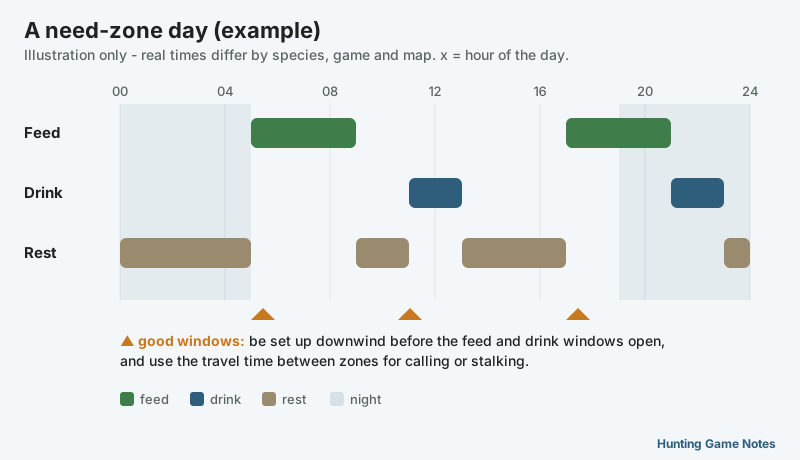
A need zone is a spot on the map where a species goes to do one thing — feed, drink or rest — during a certain window of the day. In Call of the Wild you discover them while you’re out (often by following tracks and sign), and once you have, the map shows the species and the times it uses each zone.
That’s the whole trick: instead of wandering, you go to the right zone at the right time, set up downwind, and wait.
Call of the Wild: need zones on your map
The official store page only says that animals have “complex animal behavior” and that the wild reacts to your every move
. The details of how need zones work come from playing the game and from the community. Here’s what players commonly report — treat these as community findings, not official rules:
- Three kinds: feed, drink and rest.
- Set time windows for each species, so the same spot can be busy at dawn and empty at noon.
- Zones can be big — players describe them covering a lot of ground, not a single point.
- Hunting a zone hard can make it fade. Players report zones disappearing after several kills, though they disagree on exactly how many and on how it resets.
- Calling works best between zones. Some players say animals busy feeding or drinking react less to calls than animals on the move.
Fan wikis and Steam guides list need-zone times for every species and map, but they don’t always agree with each other, and older ones predate map updates. Check the times in your own game.
Way of the Hunter: daily life cycles
Way of the Hunter is built around the same idea, and its developers have said a bit more about it in their own words:
- In a developer FAQ post on Steam they wrote that they have experts who studied every animal’s behavior, and:
We know where each animal goes to sleep, eat and drink, and the design of the game reflects it.
- In an interview with GamingBolt, they said animal behavior
is based on their needs
, balanced against what’s fun to play. - The store page promises
realistic behavior models
andtrue to live animal group behavior
.
In practice, players describe every species eating, drinking and resting at specific hours, and some animals using more than one zone of each kind. A popular free community tool, the Way of the Hunter Toolbox web app, has interactive maps and each species’ life cycle — handy for planning when to sit a zone.
Way of the Hunter also adds herd management — choosing which animals to take so the best ones get to grow old. That changes how you treat a routine: you’re not just finding animals, you’re getting to know a group.
theHunter Classic: tracks first
Classic, which shuts down on November 11, 2026 (what’s confirmed), never put routines on your map like Call of the Wild does. Its store page talks up realistic animal behaviors
and reading tracks well enough to tell weight and gender from a simple animal track
. Finding an animal meant picking up a track and following it — slower, but many Classic players loved exactly that.
Nerdy confession: watching a herd walk into a drink zone right on schedule is one of the most satisfying feelings in gaming. It’s like the game winking at you.
Side by side
| Call of the Wild | Way of the Hunter | theHunter Classic | |
|---|---|---|---|
| Routines | Need zones: feed, drink, rest | Daily life cycle: eat, drink, rest | Not shown on the map |
| How you learn them | Discover zones in the field; map shows times | Observe animals; community tools chart hours | Read and follow tracks |
| What the developers say | General: complex, reactive behavior | Built on where each animal sleeps, eats and drinks | General: realistic behaviors |
| Extra layer | Zones can fade under pressure (community) | Herd management | Deep track reading |
How do you use routines in any hunting game?
- Find the zones first, then plan your day around them.
- Arrive early and settle in before the window opens.
- Come in with the wind in your face — scent and noise matter in all of these games.
- Don’t hammer one spot. Spread your hunting across zones.
- Use the gaps. Between zones, animals are moving — that’s when callers and stalking tend to pay off.
Good audio helps more than people expect — a decent gaming headset makes it easier to hear animals moving between zones.
So grab a coffee, open the map and start learning your animals’ daily diaries. They’re more predictable than they’d like you to think.
Sources and further reading
- theHunter: Call of the Wild on Steam — official description (Expansive Worlds / Avalanche Studios)
- Way of the Hunter on Steam — official description (Nine Rocks Games / THQ Nordic)
- Way of the Hunter developer FAQ (Steam) — "We know where each animal goes to sleep, eat and drink"
- GamingBolt: Way of the Hunter interview — behavior based on animal needs
- Way of the Hunter Toolbox (community web app) — interactive maps and species life cycles
- theHunter Classic on Steam — track reading; no longer sold
- Call of the Wild Steam discussion on need zones — community findings
Questions and answers
What are need zones in theHunter: Call of the Wild?
Places where a species feeds, drinks or rests during set times of day. Once you discover them, your map shows the species and the time windows, so you can be there when the animals are.
Why did a need zone disappear?
Players report that zones can fade after several animals are taken there. The developers haven’t published the exact rule, so treat counts you see online as community estimates.
Does Way of the Hunter have need zones?
It has the same idea: each species eats, drinks and rests at specific times and places. Its developers say the game reflects where each animal really sleeps, eats and drinks.
Did theHunter Classic have need zones?
Not on the map the way Call of the Wild does. Classic focused on finding animals by reading and following tracks.